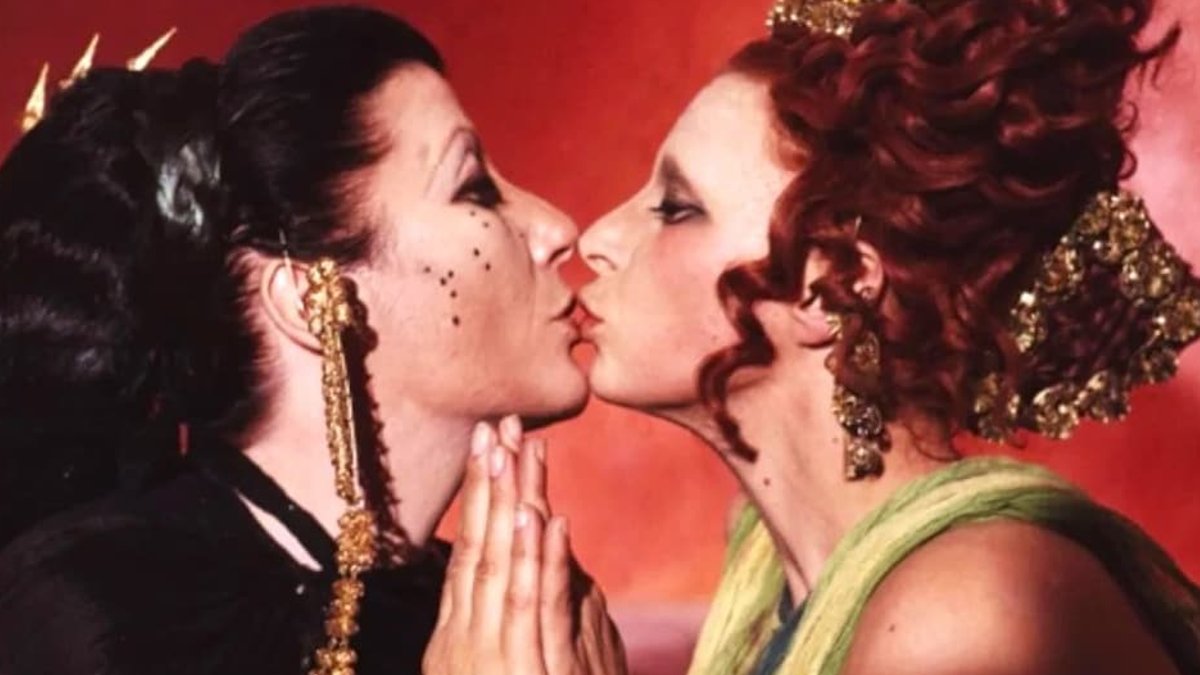
7 cult films that will transport you to the ancient world offer a stark contrast to the polished realism of modern historical epics. In the 1960s and 1970s, European auteurs turned away from spectacle and towards the more intimate, strange, and sensual aspects of antiquity. Whether drawing directly on ancient texts or on historical figures and mythology, these directors used the classical world as a canvas for something deeply personal. Working like archaeologists, they pieced together fragments, histories, and rumors to imagine lustrous worlds that were at once ancient and entirely their own.
Surreal Rome in Fellini’s Satyricon
Federico Fellini’s interpretation of Petronius’s Satyricon is a surreal jewel. The film follows the carnivalesque adventures of two young men, both in love with the same enslaved boy, across the Mediterranean: a delirious odyssey of their own. Along the way, they survive barbaric banquets, psychedelic brothels, and imprisonment by pirates. Filmed at Rome’s Cinecittà studios, the movie is a perfect expression of the director’s extraordinary vision. Fellini had no interest in producing a faithful adaptation or realistic depiction of antiquity; instead, he transforms Imperial Rome into a space-age fantasy imbued with the hippie spirit of the late 1960s.
While the visual style feels like a dream, the narrative structure relies heavily on the original Roman novel’s fragmented nature. The source material survives only in fragments, and Fellini mirrors this by presenting a series of disconnected episodes. This disjointed approach forces the audience to engage with the imagery rather than follow a linear plot. The result is a film that feels less like a history lesson and more like a fever dream.
Pasolini’s Oedipus Rex
Arguably as well-known as the story of Odysseus, Oedipus Rex needs little introduction. Pier Paolo Pasolini took on Sophocles’s tragedy of incest and parricide in 1967 for his first feature-length color film. It forms the middle part of an unofficial ancient-world trilogy, beginning with The Gospel According to St Matthew in 1964 and culminating with Medea in 1969. Franco Citti plays the hero doomed by prophecy, while the great Silvana Mangano appears as his mother, Queen Jocasta, whom he is fated to marry.
Related: Exploring the Films of David Cronenberg
Though the film takes place in an unspecified ancient past, it begins and ends in the 20th century, collapsing the distance between antiquity and the modern day. Pasolini fills his starkly beautiful world with Romanian and Japanese folk music, as well as spectacular, ahistorical costumes and masks. He claimed that because the story of Oedipus is a myth, “it is meta-historical,” and his interpretation of the tale is entirely his own.
The Tragedy of Cleopatra
An exception has to be made for perhaps the most notorious film ever made, and one that surprisingly few people have actually watched: Joseph L. Mankiewicz’s quixotic spectacle, Cleopatra. It stars Elizabeth Taylor and Richard Burton, whose affair on set led to one of cinema’s most colossal unions. You’ve seen the pictures: Taylor glittering in her wigs and heavily painted eyeliner; Burton tanned and smoldering in a toga. Yes, it’s over four hours long, but with a handy intermission at the halfway point—dividing Cleopatra’s romance with Julius Caesar from her later relationship with Marc Antony—it’s doable, and not that much longer than a Nolan film.
Like Fellini Satyricon, it was filmed at Cinecittà after an ill-fated attempt at the gloomy Pinewood Studios. On-set disasters ranged from antipathy between horses and elephants—no CGI back then—to unexploded Second World War landmines, a sandstorm, and cats giving birth beneath the sets. Then there was the tabloid whirlwind surrounding the production, not to mention Taylor’s staphylococcal pneumonia, tracheotomy, meningism, tooth abscess, brucellosis, phlebitis, and multiple suicide attempts, among other crises. As both Taylor and Burton were married, their affair was condemned by the press and even denounced by the Vatican as “erotic vagrancy.”
The production is a paragon of cinematic excess: tens of thousands of extras, 26,000 costumes, the near-bankruptcy of Twentieth Century Fox, and one of the greatest-ever cases of life imitating art.
Related: Taylor Swift Not First to Wed at Madison Square Garden
St Sebastian in Derek Jarman’s Version
Derek Jarman’s retelling of the life of St Sebastian—his first feature-length film and the first ever made entirely in Latin—had to be included on this list. Accompanied by an atmospheric Brian Eno soundtrack, the film follows St Sebastian, one of Emperor Diocletian’s guards, in the lead-up to his martyrdom.
Jarman was inspired by the iconography of St Sebastian, whose arrow-pierced body had long made him a gay icon. He wrote a script about his life, then hired a scholar to translate it into Latin. The male body, viewed through an unapologetically homoerotic lens, is central to the film, and its depictions of gay sex were new, provoking outrage—particularly when it aired on Channel 4 in 1985. Sardinian beaches and rocks stand in for the Roman world, and the crew had to conceal scenes of male nudity from curious and angry locals. For the riotous opening orgy sequence, Jarman cast a flamboyant group of London punks, artists, and dancers, creating a moment in which, in his own words, “modern London winked at Ancient Rome.”
The Madness of Caligula
The story of Emperor Caligula, a tale of power, corruption, and madness, was infamously tackled by softcore maestro Tinto Brass in the late 70s. The Romesploitation classic stars Malcolm McDowell as Caligula, alongside Teresa Ann Savoy as his sister (and lover) Drusilla, and Dame Helen Mirren as his wife, Caesonia.
This was another troubled production. Screenwriter Gore Vidal was unhappy with Brass’s rewrites, and during the editing process, producer Bob Guccione, the founder of Penthouse magazine, inserted extraneous hardcore porn footage to spice it up. The film, which was banned in many countries, remains erotic and deeply shocking. The sets by Danilo Donati, who also designed Fellini Satyricon and Oedipus Rex, are spectacular; his contributions to the visual worlds of these films deserve to be celebrated.
Related: Young Miko excels as lesbian matchmaker
Though badly reviewed at the time, it is now considered a cult classic. In 2020, producer Thomas Negovan utilized the original camera negatives to reconstruct a version closer to the creators’ original vision, and in 2023, Caligula: The Ultimate Cut premiered at Cannes, 44 years after its initial release. McDowell posted on Instagram: “Because of the brilliant work of Thomas Negovan, one of my best performances has finally come to light after 47 years!” And his performance, especially in this new version, really is brilliant. I am a proud Caligula defender.
Othon and the Clash of Eras
Commonly known as Othon, the film’s original French title translates to the rather less catchy Eyes Do Not Want to Close at All Times or Perhaps One Day Rome Will Allow Herself to Choose in Her Turn. French communist filmmaking couple Jean-Marie Straub and Danièle Huillet directed the film, based on Pierre Corneille’s 1664 play about Roman politics in 69 AD. The narrative follows Emperor Galba’s decision over whom to appoint as his successor: the weak but noble Pison, or the ambitious and cunning Otho.
Shot among the ruins of Rome’s Palatine Hill, the actors roam with the modern city in full view, its notorious traffic a constant presence. Though the film is deliberately difficult to follow, with its rapid, flat delivery, the blending of ancient and modern is fascinating. The viewer becomes hypnotized by the flow of dialogue, the sound of the fountain, and the beauty of the 16mm photography. Othon is the polar opposite of a Christopher Nolan film, and a remarkable work of art.
Youthful Love in Young Aphrodites
Young Aphrodites is a quiet pastoral drama based on the poetry of Theocritus and Longus’s Hellenistic romance novel Daphnis and Chloe. Set in 200 BC, the film follows a group of shepherds who venture to new pastures, where two parallel romances unfold: one between two young adults, and another between a young boy and girl. It is tender and erotic, and portrays their rituals of courtship, which involve animals and birds—many of the actors were real-life shepherds. Dialogue and action are sparse, in contrast to the sword-and-sandal genre that was popular at the time, and Nikos Koundouros won Best Director for Young Aphrodites at the Berlin Film Festival in 1963. It is a sensual, beautiful story of young love in an innocent yet cruel world.





Leave a Reply