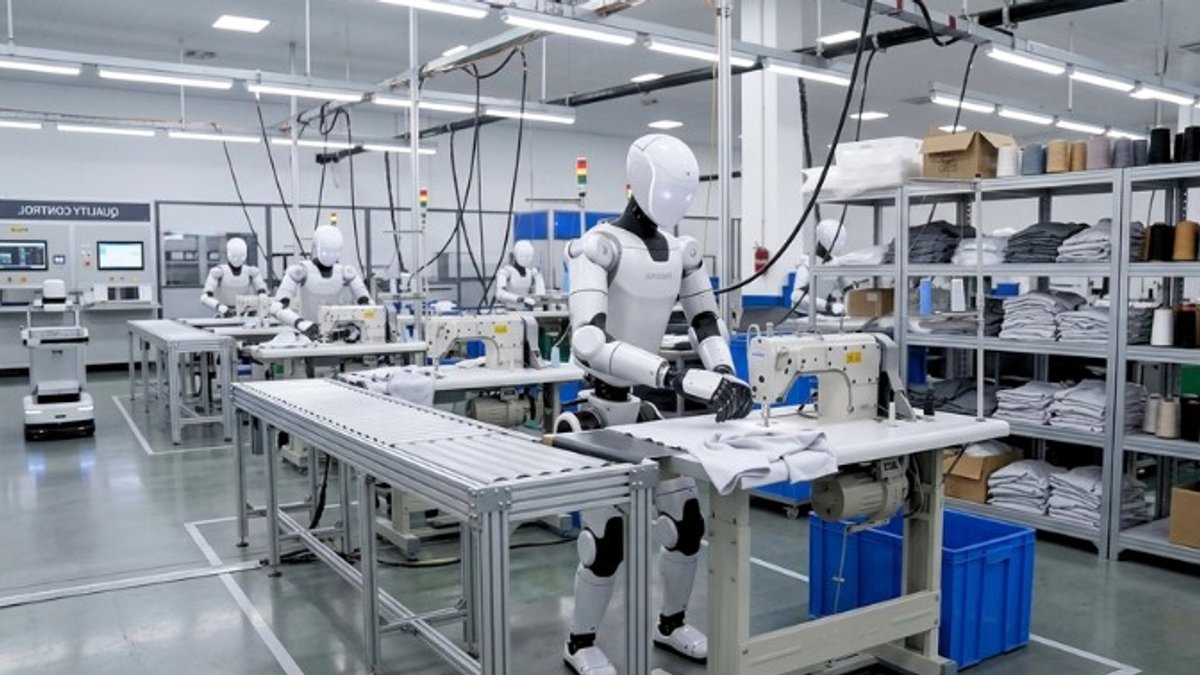
The majority of functions in a manufacturing workplace, including apparel manufacturing, require hand manipulations with limited or stationary lower body movement. Sewing, ironing, checking, and folding are examples of tasks that only require upper body movements.
A six-axis cobot, commonly used in manufacturing, has 6 degrees of freedom, which is the minimum required to position and orient a tool arbitrarily in 3D space. Each axis is a rotary joint, and each rotary joint contributes exactly 1 DoF, highlighting the mechanical complexity of these machines.
Sewing Operation Requirements
Sewing operations specifically require dextrous hand movement of fingers and hand movement from the elbow. A pedal start-stop function is not necessary, as most commercial sewing automats already run without it. The use of dextrous hands in sewing operations is key, as it allows for the manipulation of fabric and threads with precision and accuracy.
Vision Systems Integration in the sewing process showed promise almost a decade ago with Brother’s BAS 311G and Vetron’s Autoseam. However, these systems were not popularized due to limited production and prohibitive cost. One report in 2017 mentioned that the Autoseam model was pre-booked for two years in Europe, demonstrating the demand for such technology despite its limitations.
Humanoid Robots for Sewing
It is clear that humanoid robots may not be necessary for sewing operations. While a six-axis cobot fitted with a 27 DoF dextrous end effector may perform sewing tasks, the lower body of a humanoid robot may be unnecessary and expensive. The cost of a humanoid robot can be broken down into approximately 42% for the upper body, 47% for the lower body, and 11% for the shared platform, highlighting the potential for cost savings by using only the upper body.
A humanoid robot’s lower body is costly due to its load-bearing structure, torque demand, and special actuators at the knee. So, an upper body with dextrous hands may do the sewing operations at approximately 50% of the cost of a humanoid robot!
Cost-Effective Alternatives
Sewing is a key value add operation in apparel manufacturing, contributing nearly 80% of manufacturing value add in terms of time, and simultaneously sewing operators also constitute 80% of the production workforce in a typical apparel manufacturing enterprise.





Leave a Reply