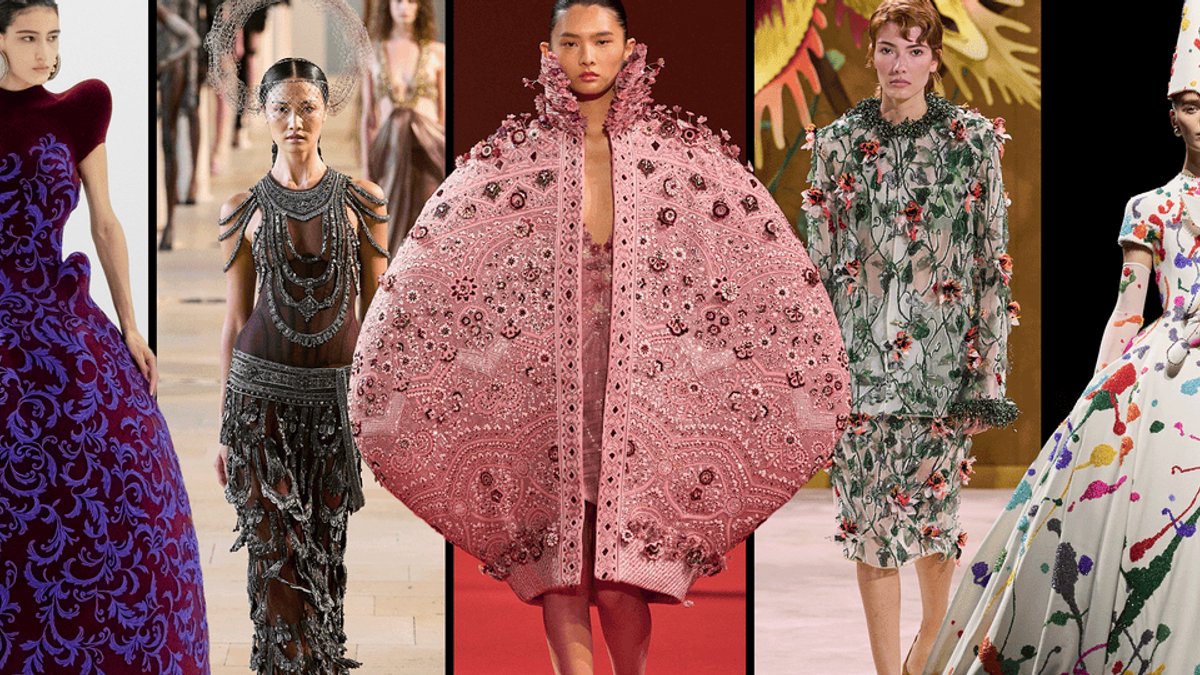
Paris’ haute couture week unfolded under temperatures that climbed to 100 °F, a stark reminder that the city’s iconic fashion houses operate amid a world facing climate strain and growing wealth gaps.
Playful fantasy replaces traditional refinement
The runway this season leaned heavily into childhood motifs, with designers turning fairy‑tale books and toy boxes into wearable art. Chanel’s Matthieu Blazy referenced a century‑old collection of stories owned by Gabrielle Chanel, translating Goldilocks and the Ugly Duckling into bear‑shaped bags and embroidered organzas. The effect felt more enchanted than childish, offering grown‑up wardrobes that resembled bedtime tales.
Robert Wun’s “Childsplay” collection amplified the camp, featuring geometric ballgowns, teddy‑bear accessories and oversized balloons that turned the runway into a circus of oversized playthings. At Schiaparelli, Daniel Roseberry explored oceanic themes, embedding lights in garments and using silicone and latex to mimic scales and tentacles. These pieces suggested a speculative anatomy, where luxury becomes a transformation of the human form.
Jean Paul Gaultier’s debut designer Duran Lantink pushed the body into cartoon‑like absurdity, with sideways dresses, tubular skirts and giant winged silhouettes that seemed to defy gravity. The technical skill behind the constructs—feathers from Maison Février and detailed embroideries recalling Versailles—showed how a joke in couture demands serious craftsmanship.
Related: Eugenie’s baby shifts royal line of succession
Global voices reshape Parisian tradition
Indian designers Rahul Mishra and Manish Malhotra highlighted how couture is no longer a solely Parisian domain. Mishra drew on the ancient Ajanta cave murals, creating structures that required multiple assistants to support them, while Malhotra’s peacock‑inspired silhouettes featured hand embroidery long valued by European luxury houses. Their work signaled a shift from invisible labor to visible authorship, though questions linger about who ultimately receives credit for the creations.
Dior’s Jonathan Anderson collaborated with 84‑year‑old American sculptor Lynda Benglis, whose long‑standing ties to Ahmedabad informed the collection’s embellishment language. This partnership illustrates an expanding dialogue between Paris and other creative centers, where cultural exchange becomes a central narrative rather than a background detail.
Critics may label these spectacles as “meme couture” or runway gimmicks, but the audience has changed. Today’s couture clients are no longer discreet “ladies who lunch.” They arrive with personal photography crews, share livestreams on TikTok and often attend other high‑profile events such as the Met Gala. Their desire for larger‑than‑life pieces fuels a market that blends ultra‑luxury with social‑media spectacle.
While the shows brimmed with whimsical excess, a parallel focus on body manipulation emerged. Jean Paul Gaultier presented a male torso that appeared digitally filtered, and Standing Ground teamed with corset‑maker Mr. Pearl to produce rigid waist‑shaping constructions. Schiaparelli displayed silicone breasts and second‑skin garments, and Robert Wun offered a shocking‑pink six‑pack. These designs reflected an industry attuned to the era of GLP‑1 weight‑loss medication, where ultra‑thin silhouettes dominate the market.
Related: Top 5 Texture Sprays for Fine Hair Without Weight
Only a few designers opted for generosity over control. Julie de Libran created pieces that emphasized ease and sensuality, while Armani Privé’s Katharine Hepburn‑style trouser suits provided relaxed alternatives to typical embellishment. Blazy’s Chanel tailoring adopted a boxy silhouette, and Dior’s Anderson softened the traditional hourglass Bar jacket into shawl‑collared shapes and tuxedo trousers.
These moments of comfort suggest that couture can offer more than a mirror of its time; it can propose alternative ways of inhabiting the body. The most viral creations this season—deformed, inflated or disguised figures—captured attention, yet the garments that truly resonated provided space for the wearer.
In an age where AI can generate images instantly and digital filters can edit bodies with a swipe, the enduring value of couture lies in its commitment to hand‑crafted, labor‑intensive creation. The runway’s fantastical displays may not solve climate or wealth crises, but they preserve the possibility of making something slowly, intricately and irreducibly by hand.




Leave a Reply